Month: April 2026

  • Cross Border Disbursement at Scale: How Banks, Telcos & NGOs Can Move Money Efficiently

    Cross Border Disbursement at Scale: How Banks, Telcos & NGOs Can Move Money Efficiently

    cross-border disbursement at scale

    Let me paint you a picture of a typical scenario that frequently occurs with funds disbursed for humanitarian purposes:

    A humanitarian organization has just secured emergency funding. People on the ground need it urgently. Not in three business days. Not after the wire clears three intermediary banks and loses 4% to fees. Now!

    The programme manager opens a laptop, logs into their disbursement portal, and… waits. The payment file is rejected. Wrong format. They try again. 

    The bank’s API is down for scheduled maintenance. Then they try a workaround. The compliance team flags it. Meanwhile, real people are waiting.

    This happens frequently with institutional cross-border disbursement, whether aid, payroll, grants, or bulk transfers. It’s one of the most chronically underserved use cases in global payments. Organizations that move large volumes of money across corridors consistently run into the same wall: the infrastructure simply wasn’t built for them.

    The good news is that this doesn’t have to be the case anymore. Modern technologies and designs are changing this. If you’re a bank, telco, NGO, or enterprise operating cross-border disbursements at scale, this piece is for you.

    The Real Problem With Institutional Cross-Border Disbursement

    Most enterprise disbursement challenges live deep in the pipelines. That is, the systems and switches that move the money from the senders to the entities. 

    When a telco wants to pay out commissions to agents spread across five African countries, or an NGO needs to fund hundreds of last-mile recipients in Ghana, Kenya, and Senegal simultaneously, the blockers are almost always the same: fragmented payout rails, inconsistent compliance posture across corridors, settlement timing mismatches, and the sheer operational overhead of managing multiple relationships with local partners.

    Throw in the compliance question — AML, KYC, sanctions screening, SAR obligations — and you’re looking at a full-time operation before you’ve moved a single dollar. Most organizations either under-resource this and run the risk of regulatory noncompliance, or over-resource it and erode margins. Neither is a great outcome.

    What institutional senders actually need is a single remittance infrastructure that handles payout diversity, centralises compliance, and gives them programmatic control over the entire disbursement lifecycle.

    What RemitJunction Does to Solve These Problems.

    KYB for businesses

    If you’re evaluating a bulk payment platform for institutional disbursement, the infrastructure conversation has to cover three non-negotiables: payout coverage, compliance architecture, and API depth.

    Payout Coverage That Matches Where Your Recipients Actually Are

    The global South, particularly Sub-Saharan Africa, is not a single market. Nigeria has NIBSS. Kenya has M-Pesa. Ghana has GhIPSS and a thriving mobile money ecosystem. Senegal has Wave. 

    A bulk remittance payments platform that only supports SWIFT wires will strand a significant portion of your recipients in every single disbursement run.

    RemitJunction supports bank transfers, mobile money wallets, and cash pickup agents, often within the same payout batch. This multi-rail payout capability is what separates serious infrastructure from glorified wrappers.

    Centralized Compliance Across Every Corridor You Touch

    Here’s where most organizations get into trouble. They build payout capability but compliance becomes a patchwork of local partners, manual processes, and well-meaning but understaffed teams trying to stay on top of 12 different regulatory environments at once. It doesn’t scale. And regulators notice.

    RemitJunction’s infrastructure runs KYC, KYB, AML screening, sanctions checks, PEP screening, and transaction monitoring from a single compliance engine; not as a checklist, but as a live, automated layer embedded into every transaction. 

    When a disbursement triggers an anomaly flag, it’s caught, held, and reviewed without manual intervention, derailing the rest of the batch.

    API Depth: Programmatic Control for Disbursement API Fintech Use Cases

    For banks, telcos, and enterprises running disbursements at any meaningful volume, manual portals are a dead end. You need a disbursement API fintech solution that lets your systems talk directly to the payment infrastructure,  triggering batch runs, querying transaction states, retrieving settlement data, and handling exceptions programmatically.

    RemitJunction’s API goes further: it gives your finance team real-time reconciliation data, automatically matching disbursement values to settlement confirmations from payout partners. 

    It gives your operations team transaction-state visibility across every leg of the payment — so exceptions surface before they become complaints. And it gives your compliance team an audit trail that doesn’t require a data engineering project to query.

    How RemitJunction Enables Institutional Cross-Border Disbursement
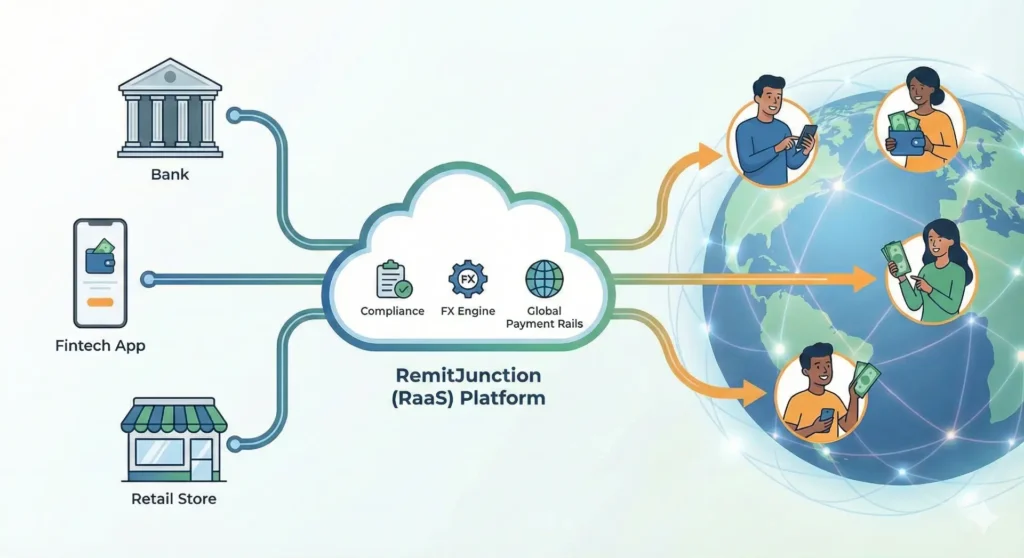
    How RemitJunction Enables Cross-Border Disbursement

    Built as an operational remittance infrastructure for regulated money businesses, RemitJunction has been processing real transactions across live corridors for over a decade, just under a different name, “MTA.”

    As a licensed principal firm, RemitJunction provides regulatory cover that institutional senders need without having to acquire or maintain their own licences. Organizations onboard as appointed agents, operating cross-border payouts under RemitJunction’s regulatory framework. 

    This is particularly valuable for NGOs asking how NGOs send money across borders without drowning in licensing logistics, and for enterprises exploring white-label remittance platforms that let them move fast without building from the ground up.

    On the payout side, RemitJunction’s network covers multiple countries with support for bank transfer, mobile money, and cash pickup — all accessible through the same integration. 

    For organizations running cross-border payroll solutions across Africa, this multi-rail capability means the same disbursement run can credit a bank account in Lagos, top up a mobile wallet in Accra, and route a cash pickup in Nairobi without managing three separate partner relationships.

    RemitJunction’s Remittance-as-a-Service infrastructure handles the compliance layer centrally — KYC/KYB verification, AML and CFT screening, sanctions and PEP checks, automated transaction monitoring, fraud detection, and SAR filing — so institutional senders don’t have to build and maintain this apparatus independently across every corridor they operate. 

    The compliance engine is embedded into the payment flow, not bolted on after the fact.

    For FX, RemitJunction gives disbursing organizations control over their pricing strategy: set your own FX margins, access live market rates, and manage currency conversion in real time. For organizations running large-volume disbursements where basis points matter at scale, this flexibility is operationally significant.

    Organizations that don’t want to build custom front-ends can deploy RemitJunction’s fully branded interfaces. 

    But for enterprises and institutional senders that need deep integration with existing systems, the API-first approach lets your engineering team plug RemitJunction’s bulk remittance payments platform directly into your disbursement workflow — triggering, tracking, and reconciling at whatever volume you operate.

    Who This Is Actually Built For

    Business man working and answering a call

    The use cases for institutional cross-border disbursement on RemitJunction’s bulk payment platform are broader than most people initially assume:

    • NGOs and humanitarian organizations that need to disburse aid or programme funds to last-mile recipients across multiple countries — and need audit-grade documentation to satisfy donor reporting requirements.
    • Telcos running agent commission payouts, airtime reseller payments, or subscriber refunds across footprint markets where the payout mix includes mobile wallets prominently.
    • Banks and financial institutions that want to offer cross-border payroll solutions for Africa-facing corridors without building and licensing an independent remittance operation.
    • Enterprises with distributed workforces, affiliate networks, or supplier bases in emerging markets who need reliable, compliant disbursement infrastructure without the overhead of managing it in-house.

    The Smarter Way Forward for Cross-Border Disbursement

    The era of stitching together five different vendor relationships to run a single disbursement corridor is, mercifully, ending. 

    The maturity of Remittance-as-a-Service infrastructures means that organizations of all sizes can now access enterprise-grade cross-border disbursement capability without enterprise-grade setup costs or timelines.If you’re ready to move past the patchwork and run cross-border disbursements on infrastructure built for the job, explore how RemitJunction powers UK-Africa corridors — or get in touch with the team to discuss your disbursement use case directly.

  • AML, KYC & Compliance in Remittance: What Founders Still Get Wrong

    AML, KYC & Compliance in Remittance: What Founders Still Get Wrong

    If you spend enough time around remittance founders, you start to notice a pattern. The product demos are slick. The growth projections are bold. The corridor strategy is usually super ambitious.

    But somewhere between the pitch deck and the first blocked transaction, reality shows up wearing a compliance badge. And that badge carries weight.

    This is where many promising businesses stall because AML compliance remittance, KYC, and KYB verification are misunderstood, underestimated, or stitched together too late.

    Let’s talk about the mistakes. The real ones that quietly kill scale.

    #1 The First Misstep: Thinking Compliance is a Product Feature, Instead of a System

    Compliance system

    One of the most common AML mistakes remittance startups make is treating compliance like a checklist.

    • Set up KYC.
    • Add a transaction monitoring system.
    • Get a policy document.
    • Launch.

    That’s not how regulatory compliance remittance works.

    Compliance is not a feature you “add.” It’s a system that touches every layer of your product:

    • Customer onboarding (KYC fintech)
    • Business onboarding (KYB verification)
    • Real-time screening
    • Ongoing monitoring
    • Reporting obligations
    • Partner-level risk controls

    Without a unified fintech compliance infrastructure, what you get is fragmentation that leads to blind spots. This is exactly why many founders struggle with how to build compliant remittance platform architecture that actually scales.

    Misconception #2: “KYC Is a Recurring Cost Centre”

    Art depicting KYC as a cost centre

    It’s common to assume KYC fintech comes with endless recurring fees per user, like a SaaS subscription that never sleeps.

    In practice, KYC setup is often a one-time integration cost, with marginal costs tied to verification events, not a perpetual drain on your margins.

    The real cost is not KYC itself. It’s poor integration, redundant checks across systems, and reverification loops due to bad data handling.

    A well-structured fintech compliance infrastructure reduces these inefficiencies significantly.

    This is why RemitJunction offers embedded compliance. We consolidate KYC fintech into a single, reusable layer instead of scattering it across vendors.

    Misconception #3: “We Need to Hire an MLRO Before We Launch”

    Hiring an MRLO to start a remittance business

    Yes, AML compliance remittance requires oversight. Yes, regulators expect accountability. But no, you don’t always need to build a full compliance team from day one.

    Many founders assume they must hire an MLRO immediately, build out an internal compliance department to monitor transactions and flag suspicious activities and set up reporting frameworks from scratch.

    In reality, modern fintech compliance infrastructure, like what we’ve built at RemitJunction, allows you to launch with a centralised compliance model.

    With our centralised compliance model, compliance operations—including AML systems for fintech scales, can be managed centrally. This removes the burden of assembling a full team before you’ve even validated product-market fit.

    Misconception #4: “A Transaction Monitoring System Solves AML”

    Transaction monitoring system

    A transaction monitoring system is important in remittance business. But it’s just part of the tools necessary to provide adequate AML oversight.

    It’s dangerous to think you can plug in one transaction monitoring system and that would be enough to cover fraud prevention and AML risks entirely.

    A simple transaction monitoring engine doesn’t provide context, especially when AML rules are too generic for specific corridors. When alerts pile up without proper triage, real risks can slip through damaging the trusts both users and regulators have placed in your business.

    Effective AML compliance system requires:

    • Context-aware rules
    • Corridor-specific risk profiling
    • Integration with KYC fintech and KYB verification data
    • Human oversight where necessary

    In other words, your transaction monitoring system must be part of a broader AML system for fintech scales, not a standalone tool.

    Misconception #5: “KYB Is Just KYC for Businesses”

    There’s a clear difference between KYC for customers and KYB for businesses. KYB verification is not just extended KYC. It’s an entirely different risk surface.

    When onboarding partners, agents, or payout institutions, you’re dealing with entities with ownership structures, cross-border regulatory exposure, licensing validity and sanctions risk at entity level.

    Weak KYB verification is one of the fastest ways to compromise compliance. And in corridors where multiple intermediaries are involved, poor KYB creates cascading risk.

    This is why scalable fintech compliance infrastructure, like RemitJunction, treats KYB as a core module, not an afterthought.

    Misconception #6: “We Can Stitch Tools Together Later”

    Stitching KYC together

    If you don’t build compliance into your product and overall business strategy at inception, this can come back to bite you. More often than not, founders often launch with fast with the leanest infrastructure underpinning their offerings; 

    • One KYC fintech provider
    • Another tool for transaction monitoring system
    • A separate fraud prevention fintech layer
    • Manual processes for KYB verification

    This works and can help remittance startups validate product-market-fit fast, verify demand and keep costs low. But when scaling starts to happen, the same fragile infrastructure can lead to data silos, inconsistent risk scoring, operational delays, regulatory exposure and more.

    Such compliance failure often costs you the very customers you acquired. Trust is broken, users flee and regulators come breathing down your neck.

    The smarter approach is to start with building your MVP with RemitJunction. Because you’re leveraging an already built infrastructure and not building from scratch, you enjoy all the cost and time benefits of launching lean. 

    But at the same time, our fintech compliance infrastructure that gives you KYC, KYB verification, transaction monitoring system, fraud prevention fintech and other compliance tools built into your product from day one.

    This way, when scaling happens, you don’t panic because the underlying infrastructure — RemitJunction in this case — was designed to support it.

    What Scalable Compliance Actually Looks Like

    If you’re serious about how to build compliant remittance platform capabilities, your compliance model should feel less like a patchwork and more like a control tower.

    Here’s what that looks like in practice:

    1. Unified Data Layer

    Customer and business data flows seamlessly across KYC fintech and KYB verification systems.

    2. Intelligent Monitoring

    A transaction monitoring system that adapts to corridor risks—especially critical in remittance.

    3. Embedded AML Workflows

    Automated alerts, case management, and reporting built into your AML systems for fintech scales.

    4. Partner-Level Risk Controls

    KYB verification is integrated into onboarding and ongoing monitoring.

    5. Infrastructure, Not Add-ons

    Compliance is part of your payment rails, not bolted on top.

    This is where payment switching becomes relevant.

    Where Payment Switching Meets Compliance

    In remittance, payments and compliance are inseparable.

    A well-designed payment switch doesn’t just route transactions. It enforces rules.

    With RemitJunction’s white-label remittance platform built on switching infrastructure, you can:

    • Apply compliance logic at the transaction level
    • Integrate KYC fintech and KYB verification directly into flows
    • Trigger transaction monitoring system checks in real time
    • Strengthen fraud prevention fintech without adding latency

    This is particularly powerful when launching corridors such as UK–Africa remittance routes, where regulatory expectations differ across jurisdictions.

    Instead of building fragmented systems, you’re leveraging infrastructure designed for regulatory compliance remittance from the ground up.

    How RemitJunction Approaches Compliance Differently

    RemitJunction’s model is built around a simple idea: founders shouldn’t have to choose between speed and compliance. 

    By embedding fintech compliance infrastructure into its payment switching layer, it enables:

    • Centralised AML compliance remittance operations
    • Integrated KYC fintech and KYB verification
    • Built-in transaction monitoring system
    • Scalable fraud prevention fintech

    More importantly, RemitJunction removes the need for founders to assemble these pieces manually.

    For a closer look at how businesses are already doing this, see how partners launch remittance businesses using this approach.

    Compliance in remittance is not where you cut corners. Get it wrong, and growth becomes fragile.
    Get it right, and scale becomes predictable. If you’re looking for profession help to build your remittance business compliantly, we’re a chat away.

  • API vs White-Label: Choosing the Right RemitJunction’s Deployment Model

    API vs White-Label: Choosing the Right RemitJunction’s Deployment Model

    The opportunity in the remittance business is glaring. Billions of dollars in remittance flowing annually globally and yet, customers demand new corridors or affordable ways to move money across borders. So it’s not uncommon to identify an untapped opportunity and see that the business case checks out. 

    But the excitement that builds in your stomach can quickly turn sour when you begin to dissect everything that goes into building a digital remittance product.

    Specifically: do you integrate a remittance API into your existing platform, or do you go with a white-label remittance platform that comes out of the box, branded and ready to launch? 

    It sounds like a straightforward technical question. It isn’t. Your answer to it will shape your cost structure, your time-to-market, your compliance obligations, your product flexibility, essentially, your entire remittance deployment model.

    Let’s break both options down properly under the RemitJunction’s RaaS business model, so you can make the call that’s right for your business.

    First, What Are We Actually Comparing?

    Depiction of API integration

    A remittance API is essentially an integration layer. You connect to RemitJunction’s infrastructure (our payment rails, FX engine, compliance tools, payout network) through a set of endpoints, and your own developers build the customer-facing experience on top of it. 

    RemitJunction’s white-label remittance platform, on the other hand, is more like buying a fully built car that’s been painted in your brand colours. The engine, chassis, interior, and controls are already there. You customise the aesthetics and some of the configurations, and then you drive it. The underlying infrastructure is managed by the RemitJunction.

    The Case for an Embedded Remittance API

    If your business already has an active user base and a functioning digital product — a neobank, a savings app, a payroll platform — embedding RemitJunction’s API into that product can be a natural and powerful move. You’re not starting from zero. You’re adding remittance capability to something your customers already trust and use.

    This approach works well when:

    • You have in-house engineering talent and the bandwidth to build and maintain the integration.
    • Your customers already live inside your ecosystem, and you want remittance to be one feature among many.
    • You require very specific, bespoke UX flows that a pre-built app might not accommodate out of the box.
    • You want granular control over every layer of the customer experience.

    Here’s the trade-off: RemitJunction’s embeddable API gives you maximum control, but it also puts maximum responsibility on your team — for building the UI, managing edge cases, handling reconciliation logic, and staying current with changes in the API. Compliance is taken off your shoulders though as this is already bundled into our API solution.

    The Case for a White-Label Remittance Platform

    If you’re launching a standalone remittance business — or entering the remittance market for the first time — a RemitJunction’s white-label platform is the faster, leaner, and more operationally sound path. 

    You get a production-ready product: a branded mobile app, a web platform, a backend agent portal, compliance workflows, FX management tools, and payout integrations, all wired up and ready to go.

    The white-label solution makes sense when:

    • You want to go to market in weeks, not quarters.
    • You don’t yet have the engineering infrastructure to build from scratch.
    •  You want compliance bundled into the remittance infrastructure — ideally under a principal firm’s license — so you can operate legally without acquiring your own remittance licence.
    • You’d rather allocate resources to customer acquisition and growth than to technology maintenance.

    The deployment model here is essentially plug-and-launch. RemitJunction carries the infrastructure weight; you carry the brand and the growth strategy.

    How to Choose Remittance Infrastructure That Fits

    A person's hand holding up multiple currencies

    When assessing how to choose remittance infrastructure, the temptation is to frame it as a binary: API or white-label. But in practice, the more useful question is: what does your business actually need to launch and operate effectively right now, and what might you need 18 months from now?

    Consider your compliance exposure first. If you’re operating in a regulated market like the UK and don’t hold a payment institution licence, your remittance deployment model needs to account for that from day one. Compliance isn’t a feature you bolt on later. 

    The good news is RemitJunction covers regulatory requirements under both the API and the white-label deployment models.  So you never have to worry about handling compliance independently whichever path you choose.

    Then consider speed. How quickly do you need to be in-market? If the answer is weeks, the white-label model wins on that dimension almost every time. If you have a longer runway, a dedicated technical team, and a very specific product vision that requires custom remittance infrastructure, the embedded API route gives you more architectural control.

    Finally, think about cost at scale. The upfront cost of our white-label solution is generally lower than building a custom integration, but the long-term economics depend on transaction volume, pricing, and how much of the operational overhead — customer support, transaction monitoring, FX management — you handle yourself. 

    The Hybrid Approach: API and White-Label Together

    Your business might launch quickly on our white-label remittance platform to capture market share, then progressively integrate deeper API connections to add bespoke features as your customer base matures. 

    Or you might run a fully custom UI on the front end — built on RemitJunction’s embedded API — while relying on our compliance layer, payout network, and operational tools on the back end.

    This hybrid remittance deployment model requires a remittance-as-a-service provider whose remittance infrastructure is genuinely composable — flexible enough to be integrated at different depths, depending on what a given business needs. RemitJunction meets all those standards and more.

    What to Expect From RemitJunction’s Embeddable API and White-Label Capabilities

    RemitJunction is built around the principle that different businesses have different deployment needs — and the platform supports both the embedded API path and the white-label remittance platform path from a single RaaS infrastructure.

    For the API-First Operator

    RemitJunction’s RESTful API suite is designed for low-code integration into existing systems. 

    Whether you’re a neobank adding remittance as a feature, or a platform business looking to embed cross-border payments into your product, RemitJunction’s API connects you to the full remittance infrastructure stack; including payout coverage across 20+ countries, real-time FX management, automated reconciliation, and a compliance engine handling AML, KYC, and CFT requirements under the principal-agent model.

    For the White-Label Operator

    Businesses that want to launch a standalone remittance product under their own brand can deploy a fully customised web and mobile app built on RemitJunction’s white-label remittance platform. 

    When launched, the remittance app is yours — your logo, your colours, your domain — while RemitJunction’s infrastructure running beneath it handles payment processing, compliance workflows, transaction monitoring, FX, and 24/7 multilingual support. 

    For the Hybrid Operator

    RemitJunction’s architecture supports a hybrid deployment where you can run a custom front end via our API while leveraging our full operational back end — the global payout network, transaction engines, liquidity partners, compliance team, FX tools and more — without having to build or manage any of it. 

    This approach suits fintech businesses that want a differentiated customer experience without the infrastructure overhead.

    What makes this flexibility meaningful is the compliance layer underneath it. RemitJunction operates as a licensed principal firm, which means you are covered under our regulatory framework without needing to obtain your own remittance licence, whether you’re using our API, building “white-label mode” or combining both. Compliance is centralised, continuously monitored, and kept current with evolving regulatory requirements across jurisdictions. 

    Additionally (and this is worth noting for businesses that want commercial flexibility), RemitJunction does not vendor-lock payout partnerships. You can bring your own payout partners or FX providers into the network, which gives you direct control over corridor economics and margin optimisation. 

    The Deployment Decision is Ultimately Yours

    API vs white-label remittance platform — at its core, the question isn’t really about technology. It’s about what kind of remittance business you’re building, how fast you need to move, how much operational responsibility you can carry, and where you want your team’s energy concentrated.

    The right remittance deployment model is the one that lets you serve your customers well, operate legally and efficiently, and scale without rebuilding your infrastructure every time your business evolves. 

    If you’re in the process of making that deployment call, RemitJunction is worth a closer look. You can book a call with us to explore the platform, ask the hard questions about compliance and corridors and pricing, and figure out which deployment model — API, white-label, or hybrid — maps cleanly onto your business goals.Talk to our team and get the details you need to deploy your remittance product the right way.