Category: Business

  • How to Scale Your Remittance Business and Unlock New Revenue Streams

    How to Scale Your Remittance Business and Unlock New Revenue Streams

    How to Scale Your Remittance Business and Unlock New Revenue Streams

    scale your remittance business

    Imagine you’ve successfully launched your remittance business. 

    Users are onboarding. Transactions are processing. Your compliance team is top notch. 

    But then you hit the familiar wall. Growth slows. 

    The corridors you serve start feeling small. Perhaps early investors are calling for further expansion.

    What’s next? How do you actually scale a remittance business without doubling your overhead, tripling your compliance costs, or starting from scratch every time you want to expand?

    That’s the question we built RemitJunction to answer. And in this piece, we’ll walk you through exactly how we help remittance businesses scale; practically, profitably, and without the usual chaos.

    1. Add New Corridors to Your Service

    Serving only one or two routes is fine for early traction, but it puts a ceiling on your cross-border payments growth and leaves significant revenue on the table. 

    The problem most operators face, though, is that adding new remittance corridors isn’t as simple as flipping a switch. It typically means new payout partner negotiations, new compliance checks for receiving jurisdictions, new tech integrations, and often, more licensing headaches.

    On RemitJunction, this process is fundamentally different. We currently support multiple corridors and we’re continuously adding new ones. When we expand our payout network, you don’t need to negotiate, integrate, or re-certify. Those new remittance corridors simply become available to you within your existing setup. That means your corridor expansion strategy is tied directly to our growth, and we’re incentivised to keep pushing that number up.

    What does this look like in practice? You log into your agent portal, select a new corridor, configure your fees and FX margins for that route, and you’re live. 

    If you’re thinking about how to scale a remittance business without burning through runway, the ability to enter new markets this quickly is a material competitive advantage.

    2. Expand Your Agent Network 

    Having reliable payout agents on the ground, whether banks, mobile wallet operators, or cash pickup agents expands your reach and how fast you can serve new customers. But building and managing that network yourself is one of the most resource-intensive parts of the entire remittance business model.

    RemitJunction provides direct access to a pre-integrated global payment network that spans bank transfers, mobile money operators, and last-mile cash pickup agents across our supported corridors. 

    So from day one, your customers’ recipients can collect funds through whichever method is most accessible to them, whether that’s an M-Pesa wallet, a bank account, or a local payout agent two streets away.

    But here’s where our agent network expansion offer gets particularly interesting: we operate a “Bring Your Own Partner” (BYOP) model. If you’ve already built relationships with payout providers, mobile money operators, or local cash agents in a specific market, you’re not forced to abandon them. You can onboard your own partners directly into your RemitJunction setup. 

    It means that as you grow, every new partner relationship you forge organically extends the overall ecosystem, making your remittance business model more resilient and more competitive simultaneously.

    Agents can also be set up across supported countries both digitally — via the platform — and in a structured sub-agency framework that allows physical network expansion. If your growth plan involves hiring on-the-ground agents in specific markets, the infrastructure to support that is already there.

    3. Unlock New Revenue Streams, Beyond Just Transaction Fees

    Woman putting banknotes in a wallet

    Transaction fees are the obvious revenue lever in any remittance business model. But if they’re your only lever, you’re in a race to the bottom with every other operator in your corridor. 

    Increasing revenue in remittance services requires thinking beyond the flat fee, and that’s exactly where RemitJunction gives you room to operate.

    FX Margin Control

    One of the more significant levers available to you on our platform is direct FX margin control. 

    Rather than going through aggregators who clip margins at every layer, you can negotiate directly with FX providers to secure tighter spreads; then apply your own markup above those rates. 

    This approach gives you the ability to gain on competitors on headline rates while still protecting, or even improving, your own margins. For any operator serious about remittance scaling, this kind of pricing flexibility is rare and genuinely valuable.

    Fee Configuration

    Beyond FX, you have full control over your transaction fee structure within the platform. You set fees per corridor, per transaction type, or flat. Whatever fits your pricing strategy. 

    Combined with the FX margin flexibility, this means you can build a tiered pricing model, offer promotional rates on new corridors, and adjust pricing dynamically as your competitive environment shifts. 

    Value-Added Services — A Growing Revenue Layer

    This is one of the most underutilised remittance revenue streams in the industry, and we think it deserves more attention. 

    Your users, particularly diaspora senders, aren’t just thinking about wire transfers. They’re thinking about topping up their family’s phone. Paying the electricity bill back home. Sending a voucher for school supplies. 

    These are habitual, recurring needs that your users are already fulfilling somewhere. The question is whether they’re doing it inside your app or somewhere else.

    RemitJunction’s Value-Added Services layer lets you offer airtime and data top-up, utility bill payments, insurance, digital vouchers, gift cards, and a growing merchant marketplace — directly inside your branded remittance app. 

    Every transaction through these services generates revenue for you. And because it deepens user engagement and increases session frequency, it also strengthens your core remittance retention numbers.

    Increasing revenue doesn’t always mean acquiring new customers. Sometimes, it means serving your existing ones better.

    4. Reduce Operational Complexity at Scale 

    There’s a version of remittance scaling that looks like success from the outside but is operationally unsustainable: more corridors, more transactions, more customers, and an operations team running at 120% capacity just to keep up.

    Things would break at that scale without streamlined operational control!

    The goal is to grow your transaction volume and revenue while keeping your operational cost structure lean. Here’s how RemitJunction helps you do just that:

    Access to Liquidity Providers

    As you grow, ensuring consistent liquidity across multiple corridors and currencies becomes a serious operational challenge. Through RemitJunction, you get access to our network of global liquidity providers — banks, payment institutions, and money transfer operators. 

    This means fewer failed transactions due to liquidity gaps, reduced dependency on a single source, and a more reliable service for your customers. All of which translates directly into better retention and fewer operational escalations.

    Centralised Compliance

    Compliance is non-negotiable but can be expensive to maintain. 

    Keeping up with evolving AML, KYC, CFT, and sanctions requirements across multiple jurisdictions often requires dedicated headcount, regtech tooling, and constant regulatory monitoring. 

    As part of RemitJunction’s principal-agent framework, we centralise this for you. Our compliance infrastructure, regtech partnerships, and in-house compliance team handle the monitoring, flagging, reporting, and regulatory updates. 

    You operate compliantly without building a compliance department from scratch.

    In-House Operations Team

    Beyond compliance, our in-house operations team supports your day-to-day business functions — from transaction monitoring and fraud detection to 24/7 multilingual customer support. This means you don’t need to hire and train a full operations function to scale. You inherit ours. 

    The cost savings here are real and compounding: lower OPEX, faster issue resolution, and a service quality standard that would otherwise require significant investment to achieve.

    Other Ways RemitJunction Helps You Scale Your Business

    Beyond the four pillars above, there are a few more capabilities worth noting for operators thinking about long-term cross-border payments growth:

    • Custom Reporting Dashboards: Real-time insights into transaction performance, corridor-level analytics, and revenue tracking — so your decisions are data-driven, not gut-driven.
    • White-Label Mobile App: A fully branded mobile experience for your users on both iOS and Android, built on our mobile SDK. This isn’t a generic plug-in — it’s genuinely customisable to your brand and UX standards.
    • Low-Code API Integration: Whether you’re embedding remittance into an existing product or launching standalone, our RESTful API suite is designed for speed and flexibility. No months-long integration projects.
    • Sandbox and Staging Environment: Build, test, and validate new features or corridors before they go live. Adding new remittance corridors strategy is only as good as the testing infrastructure behind it.
    • Startup-Friendly Pricing: Our revenue-sharing model means your costs scale with your revenue, not ahead of it. No heavy upfront investment. No fixed overheads that crush margins before you’ve hit scale.

    For a deeper look at how our white-label infrastructure works, see: Inside RemitJunction’s White-Label Remittance Platform. And if you’re still in the early stages of evaluating the infrastructure model, this is a useful read: What is Remittance-as-a-Service (RaaS) and Why It’s Powering the Next Wave of Fintechs.

    Scale Smarter, Not Just Bigger

    Scaling a remittance business

    Scaling a remittance business is about building on infrastructure that doesn’t buckle under growth. Infrastructure that handles compliance, operations, payout complexity, and FX management so you can stay focused on your customers and your margins.

    That’s what RemitJunction is built for. 

    We’ve spent over a decade in the remittance space and every feature we’ve built reflects a real challenge that remittance operators face when they try to grow. If you want to see how this works in practice for a business like yours, we’d love to walk you through it.

    Book a demo with the RemitJunction team today, and let’s map out exactly what remittance scaling looks like for your business. See how RemitJunction partners launch remittance businesses fast — and how you can too.
  • How to Launch a Remittance Business in 2026 Without Burning Capital

    How to Launch a Remittance Business in 2026 Without Burning Capital

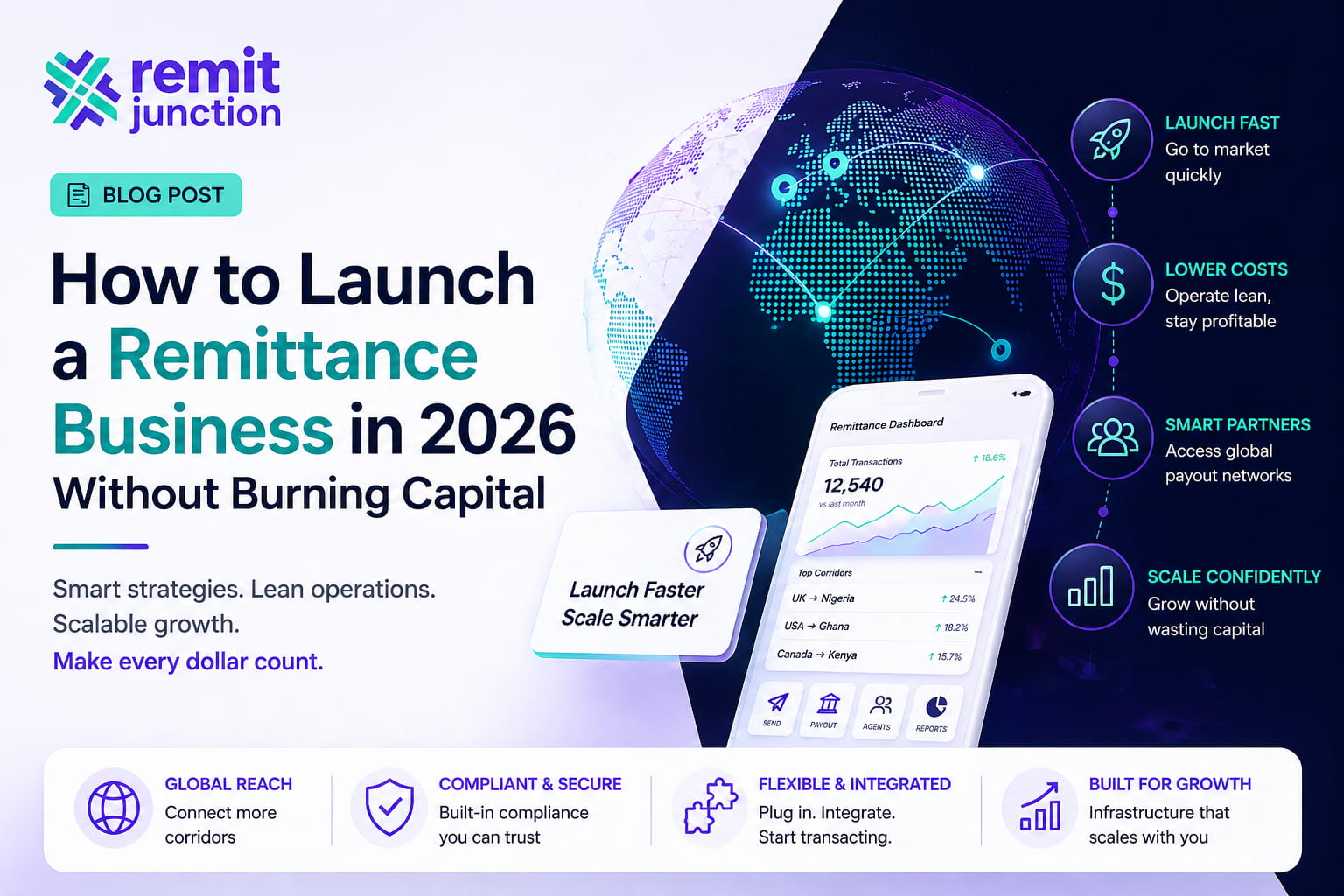
    RemitJunction blog banner: how to launch a remittance business

    Oftentimes, the cost of building a remittance platform the traditional way runs into hundreds of thousands of dollars before a single customer transacts on your platform. All of that in product design and development, not counting the budget for marketing spend later down the line.

    In 2026, the traditional approach is simply not the most efficient path to market. Not when remittance business infrastructure providers, like RemitJunction, exist to compress years of groundwork into weeks.

    This article walks you through exactly how to launch a remittance business in 2026 through RemitJunction’s end-to-end platform for launching remittance businesses, without setting your runway on fire.

    First, Understand What You’re Actually Building

    When founders talk about launching a remittance business, they often mean the customer-facing layer — the app, the brand, the corridors. 

    What they underestimate is the depth of what sits underneath: the remittance infrastructure, the licensing and regulatory framework, the AML and KYC engines, the payout network, the FX management, and the operations backbone that keeps it all running 24/7.

    Traditionally, you would build or buy each of these components separately. A tech vendor here, a compliance consultant there, a licensing attorney somewhere else. 

    That model is expensive, slow, and fragile. A single weak link — say, a payout partner going dark in a key corridor — can bring your whole operation to a halt.

    The smarter approach in 2026 is to plug into a remittance infrastructure platform that bundles all of this into one integrated solution. Which is precisely what RemitJunction is built to deliver.

    How to Start a Remittance Business in 2026 — the RemitJunction Way

    Step 1: Sign-up to Operate Under Our Licensing Framework (1-2 months)

    The single most underestimated bottleneck when you launch remittance business operations is licensing.

    Getting an FCA authorisation in the UK, for instance, is not a quick process. The application alone requires months of preparation, and approval timelines can stretch considerably further.

    For an early-stage remittance business, that is both a capital and a time drain.

    With RemitJunction, you don’t apply for your own license. You operate as an appointed representative under our principal firm framework. We hold the regulatory cover; you launch your business within it, legally and compliantly, from day one.

    This is how our partners launch a licensed remittance business in weeks rather than years — and without the prohibitive cost of building a standalone compliance infrastructure.

    If you want a closer look at how this model works in practice, our piece on how to launch a UK-Africa remittance corridor without building infrastructure goes into detail.

    Step 2: White-Label Our Tech. Build Out Your App (1-2 weeks)

    Building a remittance platform from scratch means investing in core transaction logic, the main remittance web/mobile app interfaces, customer onboarding flows, admin dashboards, reconciliation engines, and more. 

    That is a significant engineering commitment, and the cost of building a remittance platform at that level of depth is rarely justified when a fully customisable alternative is already available.

    RemitJunction’s white-label feature does this for you. 

    Once you’re legally covered under our compliance framework discussed above, the next step is to take our platform, build out your web and mobile app by configuring the brand assets, colour schemes, UX flows, product naming, and more — and make it entirely yours.

    Your customers interact with your product, not ours!

    Our remittance infrastructure simply runs quietly underneath, handling transactions, compliance checks, FX conversions, and settlement. All without your team needing to manage it operationally. 

    Now think about how much time and cost have been saved so far:

    • Regulatory cover — Cut down from 12 months and thousands of dollars to under 3 months
    • Platform engineering — Reduced from 18 months + $500k – $1m in costs, to within weeks.

    This is how you reduce fintech infrastructure cost dramatically at the go-to-market stage, while still launching a product that looks and performs like a first-class money transfer service.

    Step 3: Leverage a Global Payout Network — Without Negotiating 20 Contracts (1-2 weeks)

    Remittance doesn’t work without a reliable cross-border payout network. But access to such payout rails is where many remittance startups hit a wall early. 

    Negotiating directly with mobile money operators, local bank partners, and cash payout agents across 20+ countries is a full-time job for a team you probably don’t have yet. And vendor lock-in — where your margins are held hostage by a single payout partner — is a real risk in this space.

    With RemitJunction, you get immediate access to a global payout network covering 20+ corridors, with bank transfer, mobile money, and cash pickup options built in. And if you already have payout partners outside our network, you can onboard them directly, seamlessly. 

    This single advantage can dramatically reduce fintech infrastructure cost and go-to-market lag for any operator trying to launch a remittance business into global corridors from key markets we support.

    The global payout layer is already built into RemitJunction. At this stage in your build process, you only need to check or uncheck the corridors you want your app to support, without needing to negotiate with each individual payout partner making the corridors possible.

    Step 4: Embed Compliance Into the Product — Not As an Afterthought

    For your remittance business to operate legally, AML screening, KYC verification, transaction monitoring, PEP and sanctions checks, and SAR filing are live, ongoing operational requirements. 

    For a startup trying to launch a fintech go-to-market motion quickly, building this in-house is both risky and expensive.

    RemitJunction runs a centralised compliance framework that covers all of this for our partners. 

    As the principal firm, we bear the regulatory responsibility and ensure that every transaction processed through our remittance infrastructure is monitored, flagged, and reported in line with the applicable regulatory requirements. You benefit from a compliance-grade operation on day one, without the overhead of a full compliance team.

    The feature is a major driver to why RemitJunction is powering the next generation of money transfer operators.

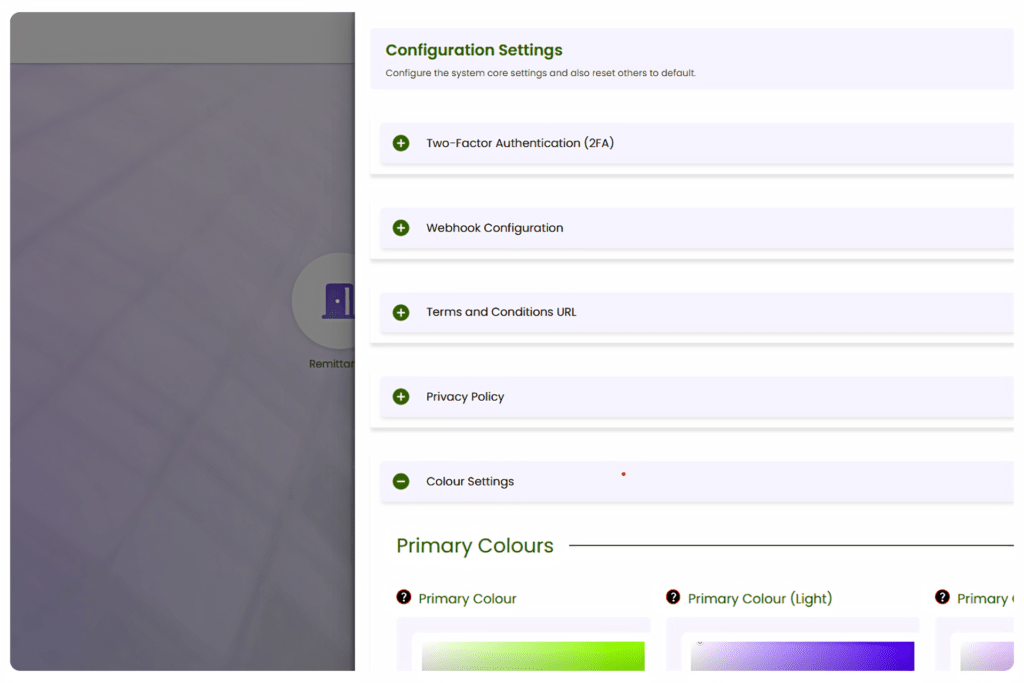
    To embed compliance at the build stage, all you need to do is configure the compliance settings your specific corridors demand. All done through a screen on the RemitJunction platform.

    Step 5: Launch Your Business! (1-2 weeks)

    With regulatory cover in place, core remittance app and underlying technological rails built, payout networks and corridors configured and compliance per region adhered to, all that’s left is to hit the “go-live” button and launch your remittance business.

    Usually, our technical and compliance teams would work with you to review every aspect of your product and business overall before launch to ensure it’s up to standard and well-roundedly compliant.

    Once launched, you can focus on onboarding, serving customers and growing your business while we handle everything else behind the curtains.

    Go Beyond Remittance: Unlock Value-Added Revenue 

    A common trap for early-stage remittance businesses is building a product that depends entirely on transaction volume to generate revenue. Margins in remittance are competitive; relying on transfer fees alone can make for a difficult unit economics story in the early months.

    RemitJunction’s platform allows you to layer value-added services — airtime top-ups, bill payments, digital vouchers, insurance products — directly into your branded app. 

    This is not an afterthought feature. It’s a genuine fintech go-to-market strategy that diversifies your revenue from the moment you launch, reduces dependency on transfer volume, and gives your customers a reason to stay engaged with your app between remittances.

    How Long Does it Take to Launch on RemitJunction?

    In practice, it takes about 8 to 16 weeks, usually depending on regulatory approvals. That’s significantly shorter than the 6 months to 18 months it takes for a well-funded remittance startup to build their product and launch to market.

    The typical journey looks like this: → sign-up to launch your business → complete your compliance assessment → get onboarded as a legally covered agent (under our licenses) → customise your white-label remittance app → configure your corridors and fee structure, and →  go live. 

    The Capital Efficiency Case in Plain Numbers

    When you consider the cost of building a remittance platform without a partner like RemitJunction, the variables stack up quickly:

    Building in-houseCosts
    Core platform development$$$
    API integrations with payout partners$$
    Regulators’ authorisation process costs$$
    Compliance team salaries$$$
    Ongoing transaction monitoring tooling$
    Customer support infrastructure$$
    Operations team to manage day-to-day$$$
    Customer acquisition and growth$$

    Against that, RemitJunction’s remittance infrastructure model operates on flexible, revenue-sharing pricing. The upfront investment is a fraction of the traditional approach. 

    With RemitJunctionCosts
    Sign-up, get covered, configure your product and launch$  (a fraction of the total in-house build cost)
    Customer acquisition and growth$$

    Your capital goes into customer acquisition and growth — where it creates actual business value — rather than into infrastructure that already exists and can be accessed through a single integration.

    That is the material difference between a fintech go-to-market strategy that works in 2026 and one that buries you in a long build cycle while the market moves on.

    Ready to Launch Your Remittance Business?

    RemitJunction is built for operators who are serious about entering the remittance space efficiently, compliantly, and profitably. If you want the technology, the regulatory cover, the payout network, and the operational backbone, without building any of it yourself, we should talk.

    Our team is ready to bring your dream product to live within weeks!