



Month: May 2026

  • Beyond Cash Pickup: Modern Remittance Payout Options Driving Adoption in Cross-Border Payments Africa

    Beyond Cash Pickup: Modern Remittance Payout Options Driving Adoption in Cross-Border Payments Africa

    In the early days of cross-border payments in Africa, cash pickup solved a real problem. 

    Limited banking infrastructure meant physical cash was the only reliable endpoint. So money service businesses, remittance operators and even the early digital remittance startups had to make avenues for cash pick-up operations.
    Today, that assumption is breaking.

    More Africans than ever are using some sort of mobile device or have access to the internet. More users now expect remittance to be digital, fast and match the speed and flexibility of the rest of their financial lives. 

    They don’t want to queue in front of cash pick-up shops, or depend on agents’ availability. They want money to arrive where they already transact: on their mobile money wallet, their remittance app wallet or their bank account!

    That shift is redefining payout options for remittance in Africa, changing the “tools” necessary to operate a successful remittance business today and who’s winning in the increasingly “digitalised money” era in Africa.

    The Hidden Limitations of Cash Pickup

    Woman putting banknotes in a wallet

    Cash still plays a role, but its limitations are becoming harder to ignore, especially at scale.

    1. Cost inefficiencies
    Cash logistics aren’t cheap. You’re dealing with agent commissions, liquidity management, and physical infrastructure. That cost either eats your margins or gets passed to users.

    2. Accessibility gaps
    Even in markets where agents are widespread, they’re not always convenient. Distance, operating hours, and local security concerns all introduce friction.

    3. Operational bottlenecks
    Cash-heavy networks are harder to scale. Reconciliation is slower, fraud risk is higher, and service reliability depends on third-party agents behaving perfectly every time—which, as most operators know, is optimistic.

    For founders thinking about alternatives to cash pickup remittance, these aren’t edge cases. They’re daily realities.

    Remittance Payout Options That Actually Drive Adoption Today

    Today’s generation of remitters and their beneficiaries expect more payout options from remittance businesses beyond cash, optimised for how they already live and transact. Here are modern payout options your business should support:

    1. Bank Transfer Remittance

    Bank transfer remittance remains one of the most trusted payout methods globally.

    It works because funds land directly in the recipient’s account. It supports higher transaction values and greatly aligns with formal financial systems anywhere in the world.

    In many African corridors, improving bank connectivity has made this option faster and more reliable than ever. For certain segments—SMEs, salaried workers—it’s often the default.

    2. Mobile Money Payouts

    bank transfer - RemitJuncttion

    Mobile wallets have effectively become the primary financial interface in several markets. Users don’t just store money there; they spend, save, and transact daily.

    It works because funds are made instantly available on the recipient’s mobile device. There is also no dependency on traditional banking. Mobile wallets are used in both urban and rural areas.

    For digital remittance solutions, this is where volume, and loyalty, often comes from.

    3. Digital Wallets

    Card payment - RemitJunction

    Beyond mobile money, broader digital wallets are gaining traction, especially in more connected markets.

    They offer faster settlement cycles, seamless integration with apps and services, and a gateway into ecosystem-based financial services.

    For operators looking at how to improve remittance adoption rates, wallets create stickiness. Once funds land in a digital ecosystem, users tend to stay within it.

    4. Airtime and Bill Payments

    Instead of sending money to be withdrawn, remitters could send value to be used directly in the form of airtime, data, utilities, or subscriptions for various needs like electricity, medical care or education.

    Embedding these payment forms into your remittance payout options reduces cash-out pressure, increases transaction frequency and creates additional revenue streams.

    It’s a subtle shift, but one that many digital remittance solutions are leveraging to deepen engagement.

    5. Agent-Assisted Hybrid Models

    Cash isn’t dead, it’s simply evolving. As a result, human agent networks are still needed. 

    However, your agent network should operate a hybrid model where digital payouts can be facilitated at the agent’s shop with assisted cash-out where needed. Think:

    • Pre-funded agent withdrawals via mobile alerts
    • QR-based pickup instead of manual verification

    These models retain the reach of cash while improving efficiency, offering practical alternatives to cash pickup remittance without fully removing it.

    Africa’s Reality: Mobile First, Infrastructure Mixed

    Map of Africa showing some African countries

    The African payments landscape is not uniform.

    On one hand, mobile money payouts dominate in markets like Kenya and Ghana. On the other, bank transfer remittance is still critical in more banked economies. Meanwhile, infrastructure gaps persist in certain regions.

    This creates a fragmented environment where no single payout method wins everywhere.

    For money transfer operators, this means one thing: flexibility is not optional.

    The real winners in cross-border payments Africa are those who can dynamically offer multiple remittance payout options, adapting to corridor-specific behaviour without rebuilding their stack each time.

    This guide on How to Launch a UK–Africa Remittance Corridor Without Building Infrastructure shows you a practical example of how payout flexibility plays out in real corridors.

    How RemitJunction Enables Multi-Payout Flexibility

    Given the increasing demand for digital payouts across African remittance markets, leveraging RemitJunction’s distinct digital infrastructure can become your competitive edge.

    Behind every seamless payout experience is a switching layer coordinating:

    • Multiple payout partners
    • Different settlement rails
    • Real-time routing decisions

    RemitJunction’s approach is built around this principle. Through our API-based infrastructure, you can:

    • Integrate diverse payout methods—from bank transfer remittance to mobile money payouts and more
    • Route transactions based on speed, cost, or availability
    • Expand into new corridors without rebuilding from scratch

    For a closer look at our product layer, you can explore Inside RemitJunction’s White-Label Remittance Platform, or see how partners go live quickly in How RemitJunction Partners Launch Remittance Business Fast in Weeks.

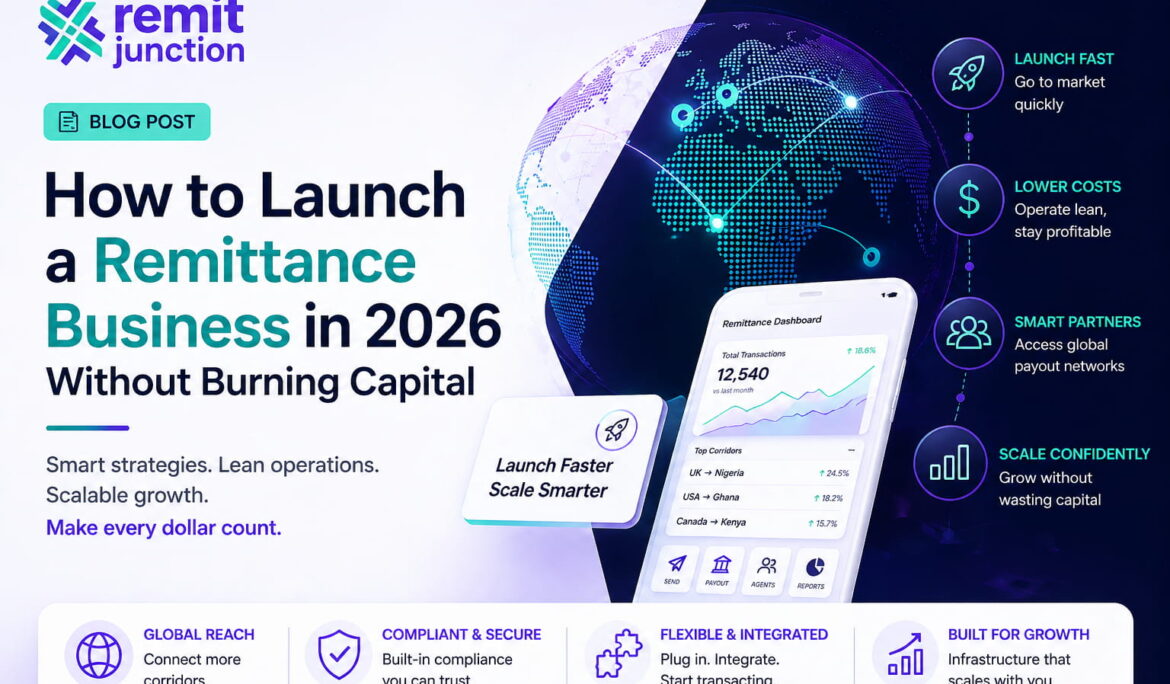
  • How to Launch a Remittance Business in 2026 Without Burning Capital

    How to Launch a Remittance Business in 2026 Without Burning Capital

    RemitJunction blog banner: how to launch a remittance business

    Oftentimes, the cost of building a remittance platform the traditional way runs into hundreds of thousands of dollars before a single customer transacts on your platform. All of that in product design and development, not counting the budget for marketing spend later down the line.

    In 2026, the traditional approach is simply not the most efficient path to market. Not when remittance business infrastructure providers, like RemitJunction, exist to compress years of groundwork into weeks.

    This article walks you through exactly how to launch a remittance business in 2026 through RemitJunction’s end-to-end platform for launching remittance businesses, without setting your runway on fire.

    First, Understand What You’re Actually Building

    When founders talk about launching a remittance business, they often mean the customer-facing layer — the app, the brand, the corridors. 

    What they underestimate is the depth of what sits underneath: the remittance infrastructure, the licensing and regulatory framework, the AML and KYC engines, the payout network, the FX management, and the operations backbone that keeps it all running 24/7.

    Traditionally, you would build or buy each of these components separately. A tech vendor here, a compliance consultant there, a licensing attorney somewhere else. 

    That model is expensive, slow, and fragile. A single weak link — say, a payout partner going dark in a key corridor — can bring your whole operation to a halt.

    The smarter approach in 2026 is to plug into a remittance infrastructure platform that bundles all of this into one integrated solution. Which is precisely what RemitJunction is built to deliver.

    How to Start a Remittance Business in 2026 — the RemitJunction Way

    Step 1: Sign-up to Operate Under Our Licensing Framework (1-2 months)

    The single most underestimated bottleneck when you launch remittance business operations is licensing.

    Getting an FCA authorisation in the UK, for instance, is not a quick process. The application alone requires months of preparation, and approval timelines can stretch considerably further.

    For an early-stage remittance business, that is both a capital and a time drain.

    With RemitJunction, you don’t apply for your own license. You operate as an appointed representative under our principal firm framework. We hold the regulatory cover; you launch your business within it, legally and compliantly, from day one.

    This is how our partners launch a licensed remittance business in weeks rather than years — and without the prohibitive cost of building a standalone compliance infrastructure.

    If you want a closer look at how this model works in practice, our piece on how to launch a UK-Africa remittance corridor without building infrastructure goes into detail.

    Step 2: White-Label Our Tech. Build Out Your App (1-2 weeks)

    Building a remittance platform from scratch means investing in core transaction logic, the main remittance web/mobile app interfaces, customer onboarding flows, admin dashboards, reconciliation engines, and more. 

    That is a significant engineering commitment, and the cost of building a remittance platform at that level of depth is rarely justified when a fully customisable alternative is already available.

    RemitJunction’s white-label feature does this for you. 

    Once you’re legally covered under our compliance framework discussed above, the next step is to take our platform, build out your web and mobile app by configuring the brand assets, colour schemes, UX flows, product naming, and more — and make it entirely yours.

    Your customers interact with your product, not ours!

    Our remittance infrastructure simply runs quietly underneath, handling transactions, compliance checks, FX conversions, and settlement. All without your team needing to manage it operationally

    Now think about how much time and cost have been saved so far:

    • Regulatory cover — Cut down from 12 months and thousands of dollars to under 3 months
    • Platform engineering — Reduced from 18 months + $500k – $1m in costs, to within weeks.

    This is how you reduce fintech infrastructure cost dramatically at the go-to-market stage, while still launching a product that looks and performs like a first-class money transfer service.

    Step 3: Leverage a Global Payout Network — Without Negotiating 20 Contracts (1-2 weeks)

    Remittance doesn’t work without a reliable cross-border payout network. But access to such payout rails is where many remittance startups hit a wall early. 

    Negotiating directly with mobile money operators, local bank partners, and cash payout agents across 20+ countries is a full-time job for a team you probably don’t have yet. And vendor lock-in — where your margins are held hostage by a single payout partner — is a real risk in this space.

    With RemitJunction, you get immediate access to a global payout network covering 20+ corridors, with bank transfer, mobile money, and cash pickup options built in. And if you already have payout partners outside our network, you can onboard them directly, seamlessly. 

    This single advantage can dramatically reduce fintech infrastructure cost and go-to-market lag for any operator trying to launch a remittance business into global corridors from key markets we support.

    The global payout layer is already built into RemitJunction. At this stage in your build process, you only need to check or uncheck the corridors you want your app to support, without needing to negotiate with each individual payout partner making the corridors possible.

    Step 4: Embed Compliance Into the Product — Not As an Afterthought

    For your remittance business to operate legally, AML screening, KYC verification, transaction monitoring, PEP and sanctions checks, and SAR filing are live, ongoing operational requirements. 

    For a startup trying to launch a fintech go-to-market motion quickly, building this in-house is both risky and expensive.

    RemitJunction runs a centralised compliance framework that covers all of this for our partners. 

    As the principal firm, we bear the regulatory responsibility and ensure that every transaction processed through our remittance infrastructure is monitored, flagged, and reported in line with the applicable regulatory requirements. You benefit from a compliance-grade operation on day one, without the overhead of a full compliance team.

    The feature is a major driver to why RemitJunction is powering the next generation of money transfer operators.

    To embed compliance at the build stage, all you need to do is configure the compliance settings your specific corridors demand. All done through a screen on the RemitJunction platform.

    Step 5: Launch Your Business! (1-2 weeks)

    With regulatory cover in place, core remittance app and underlying technological rails built, payout networks and corridors configured and compliance per region adhered to, all that’s left is to hit the “go-live” button and launch your remittance business.

    Usually, our technical and compliance teams would work with you to review every aspect of your product and business overall before launch to ensure it’s up to standard and well-roundedly compliant.

    Once launched, you can focus on onboarding, serving customers and growing your business while we handle everything else behind the curtains.

    Go Beyond Remittance: Unlock Value-Added Revenue 

    A common trap for early-stage remittance businesses is building a product that depends entirely on transaction volume to generate revenue. Margins in remittance are competitive; relying on transfer fees alone can make for a difficult unit economics story in the early months.

    RemitJunction’s platform allows you to layer value-added services — airtime top-ups, bill payments, digital vouchers, insurance products — directly into your branded app. 

    This is not an afterthought feature. It’s a genuine fintech go-to-market strategy that diversifies your revenue from the moment you launch, reduces dependency on transfer volume, and gives your customers a reason to stay engaged with your app between remittances.

    How Long Does it Take to Launch on RemitJunction?

    In practice, it takes about 8 to 16 weeks, usually depending on regulatory approvals. That’s significantly shorter than the 6 months to 18 months it takes for a well-funded remittance startup to build their product and launch to market.

    The typical journey looks like this: → sign-up to launch your business → complete your compliance assessment → get onboarded as a legally covered agent (under our licenses) → customise your white-label remittance app → configure your corridors and fee structure, and →  go live. 

    The Capital Efficiency Case in Plain Numbers

    When you consider the cost of building a remittance platform without a partner like RemitJunction, the variables stack up quickly:

    Building in-houseCosts
    Core platform development$$$
    API integrations with payout partners$$
    Regulators’ authorisation process costs$$
    Compliance team salaries$$$
    Ongoing transaction monitoring tooling$
    Customer support infrastructure$$
    Operations team to manage day-to-day$$$
    Customer acquisition and growth$$

    Against that, RemitJunction’s remittance infrastructure model operates on flexible, revenue-sharing pricing. The upfront investment is a fraction of the traditional approach. 

    With RemitJunctionCosts
    Sign-up, get covered, configure your product and launch$  (a fraction of the total in-house build cost)
    Customer acquisition and growth$$

    Your capital goes into customer acquisition and growth — where it creates actual business value — rather than into infrastructure that already exists and can be accessed through a single integration.

    That is the material difference between a fintech go-to-market strategy that works in 2026 and one that buries you in a long build cycle while the market moves on.

    Ready to Launch Your Remittance Business?

    RemitJunction is built for operators who are serious about entering the remittance space efficiently, compliantly, and profitably. If you want the technology, the regulatory cover, the payout network, and the operational backbone, without building any of it yourself, we should talk.

    Our team is ready to bring your dream product to live within weeks!